|
 |
History of the Presbyterian Church of
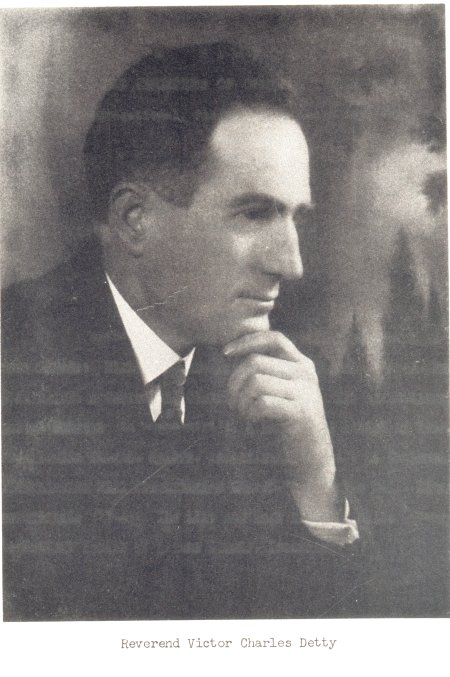
1844-1942 By Victor Charles Detty, Pastor Author of
Published by the Author 1942, Wysox, PA
|
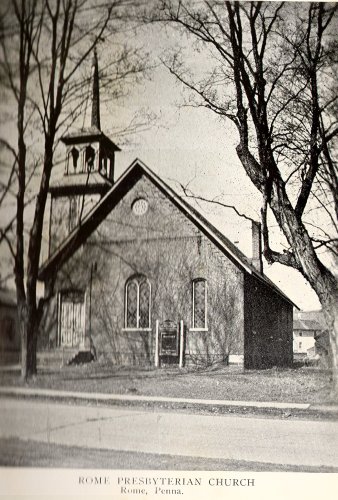
Rome, Pennsylvania was so named at the suggestion of Larmon H. Elliott, son
of William, at a meeting of citizens held in 1831 to organize a new township
from parts of Orwell, Sheshequin and Wysox townships, that since the township
was in the same latitude as Rome, Italy, this new township should take the name
of “the Eternal city.” The majority voted to accept that same.
Rome Township has an area of about thirty square miles, comprising one
thirty-ninth of Bradford County, and is drained by the Wysox Creek and its
tributaries which include Bullard, Johnson, Park’s, Hicks and Bear Creeks.
Wysox is a name derived from an Indian phrase meaning “place of grapes,”
according to the Pennsylvania state highway marker. Within the bounds of
Rome township were the Wysaukin and Minnisink Indian trails. The former
was a short cut northward going up the eastern side of Wysox Creek. The
latter was a path crossing the township on its northern border leading from the
village of Tioga to the Delaware River.
Along the Wysox Creek a broad and fertile vale extends on either side, and
ascends into high and rolling tablelands and hills. It is the scene of
dairy and poultry husbandry.
The first settler was Nathaniel Peasley Moody, who was born in Haverhill,
Massachusetts in 1760, who became the great-great-grandfather of Mrs. Marjorie
Moody Holmes, present pianist of the Rome Presbyterian Church, the line of
descent being through Moses, Lemuel L., and William L. Moody. When sixteen
years old Nathaniel P. Moody left Yale College and enlisted on an American
privateer, being captured by the British and pressed into Dutch navel service
for two years until exchanged. After that he enlisted in the Revolutionary
army, served to the close of the revolution having fought six battles, and rose
to the rank of major. After his discharge, Moody went to Great Barrington,
Massachusetts where he married Miss Susan griffin, and resided until March, 1795
when with his oxen and sled, his wife and their children, Enos, Moses and
Menzentius, he started for the then “far west”.
They crossed the Hudson on the ice at the city of Hudson, and arrived after
many weary days of travel, at Tioga Point, where they heard of a place a few
miles below called Sheshequin, whither they went, and worn with the long
journey, resolved to go no farther. Levi Thayer at that time claimed,
under the Connecticut title, not only all of the lands now included in Rome, but
a large tract of the surrounding country. His surveyor ran out the lands
into tracts, and also a township which Thayer called ‘Watertown’. Moody
helped Thayer to cut a road from the valley of Sheshequin to the Wysox Creek,
which road intersects the creek near the center of the present incorporation of
the borough of Rome. Moody purchased a piece of land of Thayer about a
half a mile lower down, near the confluence of the Bullard creek with the Wysox.
“In the autumn of 1796 he erected a log cabin, and in May, 1787, he came
with his family to his forest home. Another son had been added to his
family in the meantime, Simon Spalding Moody, who was ten months old when the
log cabin home in the wilds of Rome was first inhabited.”
On this trip night came on before they reached their cabin, and though but
a half mile distance, they were compelled to camp at the junction of Bear and
Wysox creeks. Mr. Moody with flint and steel soon kindled a fire in a dry
pine tree, in the light of which they slept on the ground, their lullaby being
the howling of the wolves in the distance. In the morning Mrs. Moody was
frightened at what she supposed were Indians, but who proved to be some settlers
from below—Henry Tallady, Peter Florence, Matthias Fencelor (the hermit), and
Mr. Hathaway. They had been hunting and had a wolf by his heels on a pole,
which they bore on their shoulders, past the encampment. It was small
wonder that a Massachusetts woman should mistake such costumed men for natives
of the forest. It was a glad surprise to her, however, to learn she had
white neighbors so near,--four miles distant.”
The Matthias Fencelor referred to was a hunter who lived as a hermit at a
place now owned by Mr. Smith A. Forbes in Wysox township. One time when
returning from Sheshequin by way of Bullard Creek, he found himself being
followed by wolves when darkness overtook him before he could reach his cabin.
He found a rock cliff jutting out from the creek bank which could be reached
only across a narrow neck of ground. Here he built a fire and tended it
all night, for he knew that the wolves, whose green eyes reflected the firelight
on the other side, would not cross the passageway as long as the fire burned.
When dawn came he saw them slink away into the woods, and not long afterward he
made his way down the creek to his cabin. The place of vigil became known
as Fencelor’s Fort, and may be see along the North Rome road, a little east of
the farmstead of Mr. Avery Forbes, which was settled by William Elliott.
The next year after Nathaniel P. Moody came (1798), Godfrey Vought, Henry
Len and Frederick Eiklor came from Catskill, New York, with their families.
They were all Revolutionary soldiers.
According to Rev. David Craft’s History of Bradford County, Moody and
Eiklor exchanged farms about 1800, and as Moody had the most cleared land,
Eiklor paid him one hundred pounds of ample sugar for the estimated difference
in the value of the farms.
“Soon after Mr. Moody settled on his farm he disposed of his oxen, and
thenceforth contended with the heavy forest without a team. Two or three
acres was the extent of the clearing made, the logs being rolled together by
hand, and the wheat then sown and hoed in.”
John Parks came in 1801 and settled the place owned in 1878 by Dan C.
Wattles, now by Leon Bidlack, on the highway to Wysox. Elijah Towner, a
Revolutionary soldier under Arnold, came first from Danbury, Connecticut, and
next from Columbia County, New York, and settled on Towner Hill in 1806 after
having lived on various farms near Sheshequin for a number of years. He
was the ancestor of Daniel B. Towner, gospel song composer.
George Murphy settled on Towner Hill in 1803 and lived to be over a hundred
years old. He was a son of John Murphy who was slain at the battle of
Wyoming. John Hicks came to the hollow west of him in 1804. In 1805
William Elliott came to Rome bringing a party of nineteen, and settled on a farm
on Bullard Creek. A descendant, Joseph Elliott, lives near the old farm.
Achatius Vought, a brother of Godfrey, began a clearing on Park’s Creek,
about two miles northwest of Rome village, in 1807. Reuben Bump, of
Hugenot descent, and a veteran of Bennington and Saratoga, came to the
northwestern part of the township in 1806, with his brother-in-law, Russell
Gibbs, a native of Vermont.
Peter Johnson, a native of Great Barrington, Massachusetts, came to Wysox
in 1796, married Sarah Moger about 1799, and settled on Johnson Creek in the
southern part of what is now Rome Township. He operated a farm and a
saw-mill. He had four sons—Hiram, Miner, John, Herbert; and three
daughters—Polly, Eliza, and Amanda.
Other pioneer settlers included, according to c. F. Heverly’s History and
Geography of Bradford County, Jacob Wickizer from Luzerne County, who with
Willard Green, bought land and settled on Johnson Creek. John Horton came
from Wyoming in 1811 and settled on Wysox Creek. Isaac Strope, a son of
John Strope of Wysox, settled in Vought Hollow about 1813. Simeon Rockwell
came in 1815 from Connecticut, was a cabinet maker, and also farmed. John
Kneeland, said to have been in the “Boston Tea Party,” having served on land and
sea in the Revolutionary War came to Rome in 1816, a native of Massachusetts.
Sylvester Barns, born in Connecticut, came in 1813, bought the Ridgway mill in
1819, and became a Baptist deacon. Other settlers were David Weed, a
wearer of deerskin dress; Edward Griffin, a miller on Bullard Creek, Samuel,
Ephrian H. and Isaac Parker, locating at Bumpville; Eli Morris coming from Green
County, New York in 1825; Lewis Goff and Nathan Maynard in 1930; Walter S.
Minthern and Silas Cole, 1930.
The territory now included in the village borough of Rome was once divided
into two school districts, known as the upper and lower districts. The
Baptists held their meetings in the lower, and the Methodists in the upper
school house. In 1827 Deacon Stephen crammer, who came to Rome in 1812,
organized the first Sunday School of the township in the lower school house and
was its superintendent for several years.
On May 18, 1835 the Methodists organized a Sunday School in the upper
school house, and continued it there until they began to hold their meetings in
the Baptist Church, which was the first church edifice erected, some two or
three years previous to the building of the Presbyterian Church which was
organized in 1844. The Methodist house of worship was built by George W.
Eastman and dedicated in February, 1850, when the population of the town was
1308.
The first religious service was held at the house of John Parks, in 1801.
The preacher was Elisha Cole of Monroe Township, a Methodist.
The first school teacher was Frederick Eiklor, brother of Mrs. Jesse Allen
of Pond Hill (Lake Wesauking). He taught in the first log school house
built in the township, in 1803, or near that time. It stood near the
present farm home of Mr. Ulysses M. Holmes, formerly occupied by Oscar F. Young.
James Moore, a native of Ireland, lived for a time on the Hudson where he
married Eunice Van Buren. He settled on Towner Hill about 1808. Once
of his children was named Martin Van Buren Moore, and Craft says he was so named
for his maternal grandfather. One of his daughters, Elizabeth, married
Enoch Towner, and named one of her sons Martin van Buren Towner. She bore
seven sons and seven daughters.
The Reverend Corrington E. Taylor’s father, Benjamin, came from Connecticut
in 1817. He was a native of Groton, and his wife, whose maiden name of
Bathsheba Janes, was born at Springfield, Massachusetts. Her brother,
Bishop Edmund S. Janes, was one of the founders of Drew Theological Seminary.
Benjamin cleared a farm in the eastern part of the township, known as Taylor
Hill, where descendants still live. An article by Rev. C. E. Taylor shows
the pioneer conditions of early Rome, and is printed below.
By Rev. Corrington E. Taylor
The approach from the west is easier and from the south still much easier. From the east there is now no road, though there used to be. It lies directly east from the borough of Rome, about one and a half miles. Its surface is quite uneven, yet scarcely a foot but what may be cultivated.
FIRST SETTLERS
Here in this wilderness home on the 11th day of Aug. 1818, the writer of these lines first saw the light of the sun, being the first white child born on Taylor Hill. “Aunt Chloe” wife of the late James Lent, I have been informed, was the conspicuous and the very responsible person on that occasion. My father finding it quite difficult to support so large a family in such a forest home, and as he was a cooper by trade and as his work was much wanted in Wysox, Shepard Pierce, an old acquaintance, persuaded him to move down there and work at this trade. This he did, living in a house which stood a few rods below where the family residence of the late Mr. Pierce now stands. He remained there about three years. As my mother was a weaver she did much in that line towards supporting the family. Here he lost a valuable cow and on a post-mortem examination a quantity of pounded glass was found in her stomach. She had troubled a certain neighbor, and one of the sons of that neighbor had sworn vengeance against her. But on the whole he was prosperous, and when he returned to his forest home he took with him three cows and forty sheep, and was well provided with household furniture. Soon after their return a chimney was built in the house. This under the circumstances was rather a difficult job, for the mason must stop while the dinner was being cooked. When completed it was furnished with a log-pole, but this was quite as troublesome as well as dangerous thing, for occasionally it would take fire and burn in two and let the pole and kettles down into the fire. I remember on a certain occasion that we children were boiling sap and our parents were both gone, when we looked and beheld the log-pole on fire. I remember how we cried and took on, expecting every moment that it would give away, and the kettles with their boiling contents would come down with a crash into the fire; but to our great joy our parents returned in time to relieve us of our trouble. After a while an iron crane was obtained and put in, as a substitute for the log-pole, and it seemed like an acquisition of almost infinite importance. But the hand that fashioned it (Nathan Maynard) has these long years been moldering in the dust, and the anvil no longer echoes to the stroke of his hammer. That crane is still in existence, my oldest brother having it in use. Sacred relic! What remembrances gather around that old crane! Few children of the present generation ever saw one, or know what it is, it is now stoves! Stoves! Stoves! Then such a thing as a stove in this country was hardly known. I must have been ten or twelve years of age before I ever saw one, and perhaps fifteen before I saw a cooking stove. How great the change!
The woods gradually receded. We generally cleared three or four acres a year and put it into wheat, and hardly ever failed of getting an abundant crop. This, with the minor crops, furnished enough for the family and some to spare. The virgin soil which had remained uncultivated through all the past age was wonderfully productive. Some of the land was what is called windfall—where the trees had been blown down and was covered with briers. This was easily cleared, and could be immediately plowed, as the roots of the trees were nearly all gone, and the crops of corn, buckwheat, potatoes, etc., raised upon it was very large.
The cattle and sheep daily ran at large, to a great extent at least, as it was some years before pasture could be given them. The cows had among them the “bell cow” and the sheep the “bell sheep”. The cows must be at home every night in order to be milked, and the sheep be in a fold near the house to protect them from the wolves. The cows would generally come by choice to get their bags relieved of the day’s accumulation, but the sheep must always be sought for, and securely penned. Occasionally the cows would stay away, or in some manner be hindered from returning at night, and then a search would be commenced for them, lasting into the night or perhaps all of the night. This was a painful supplement to the farmers after a day of hard toil. Now and then, in spite of all the care exercised, the hungry wolf would succeed in entering the fold and satisfy his hunger upon some member of the flock. The number of hawks, owls, foxes and skunks made great watchfulness necessary over the poultry, by day and night. The deer and squirrels were soon to obtain part of the different kinds of grain, and the quails and pigeons did not go hungry. But still amidst all, by industry and frugality, the wants of the family were well supplied and some advancement made every year “something being laid aside for a rainy day.”
The above Annals of Taylor Hill were written by the Reverend Corrington E. Taylor, a Methodist minister, son of Benjamin Taylor, who was the great-grandfather of Mr. Harold Taylor of Brooklyn, N.Y., and of Mrs. Albion Jenkins, his sister, who make their summer home in Rome. Rev. Corrington E. Taylor died in 1888 at the age of 70 years. He had no surviving children.